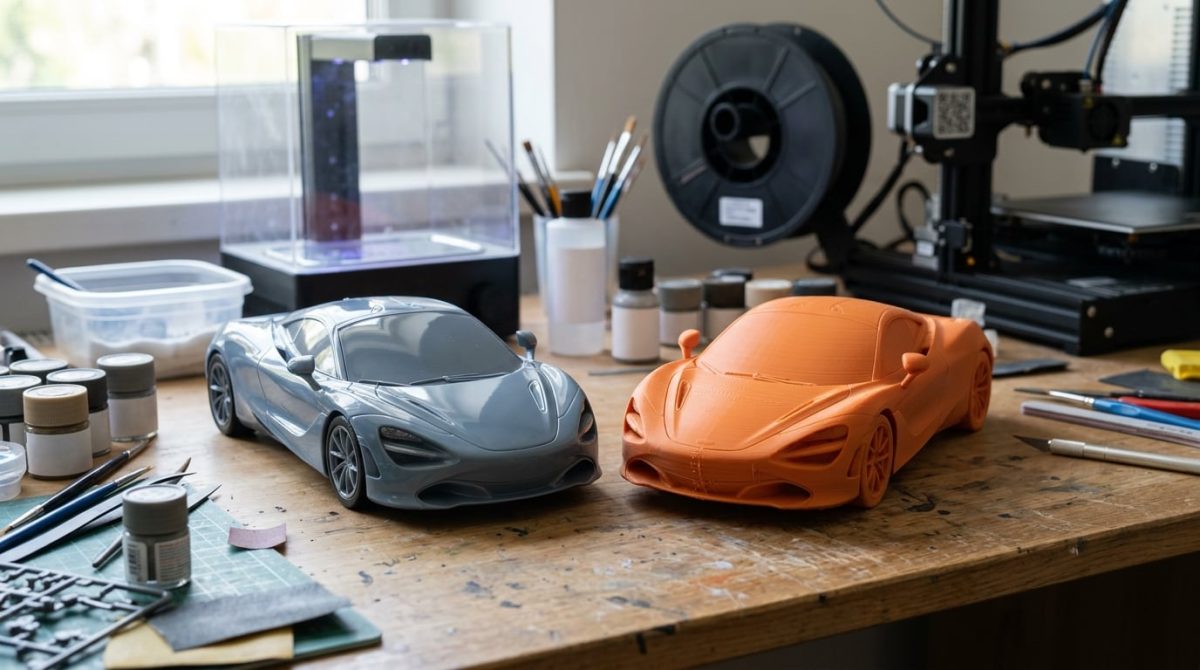



From the humble Ferguson TE20 to mighty articulated giants, these classic tractor STL models bring farm history to your print bed.
Few machines carry as much quiet history as the farm tractor. Classic tractor STL models let hobbyists relive that history on their own print bed, turning decades of agricultural engineering into shelf-ready miniatures. Whether you collect scale replicas of muscle cars or military trucks, adding a classic tractor to the lineup brings a grounded, nostalgic counterpoint to the garage.
Tractors are also wonderfully satisfying subjects for 3D printing. Their chunky tires, visible engine blocks, and boxy cabins translate beautifully into both resin and FDM prints, and the flat panels and large surfaces make painting a relaxed, rewarding process compared to the tight curves of a sports car body. This roundup gathers seven of the best classic tractor STL models available, spanning continents, decades, and the companies that shaped modern farming.
Seven Tractors, Decades of Farming History
A curated set of printable farm legends, from post-war classics to modern articulated giants.
Why Classic Tractor STL Models Belong in Every Collection
Farm equipment rarely gets the spotlight that sports cars and fighter jets enjoy, yet tractors shaped the modern world arguably more than any car ever did. Printing a classic tractor model is a way to honor that engineering legacy while building a genuinely unique display piece.
These designs also pair naturally with other machinery in a collection. If you already print Chevrolet STL Collection: 50+ Printable Models or enjoy Best Classic American Muscle Car STL Models, a row of vintage tractors adds welcome variety to a shelf otherwise full of sedans and muscle cars.
The Seven Best Classic Tractor STL Models to Print
Below are our picks, organized by manufacturer, covering everything from the tiny Ferguson TE20 to the modern articulated Case IH Steiger. Each entry includes real specs about the actual machine, plus printing and painting notes.
1. Ferguson TE20
The Ferguson TE20 is arguably the most important tractor of the 20th century. Designed by Harry Ferguson, it introduced the three-point hitch linkage system that remains the global standard on tractors today, revolutionizing how implements attach to farm machinery. You can read more about its inventor on the Harry Ferguson Wikipedia page.
Over a million units were built across the UK, the US, and France, and surviving examples are prized by collectors worldwide for their simplicity and historical weight. The TE20’s rounded grey body and narrow stance make it an ideal subject for beginners tackling classic tractor STL models, since its compact size means fast print times even on smaller build plates.
For paint, the classic "Ferguson grey" is achievable with any light grey primer followed by a satin grey topcoat; add orange or red pinstripe decals for extra authenticity. FDM printing works well here thanks to the tractor’s simple geometry, though resin will sharpen the grille and gauge details. This same subject is also available as a multi-piece build in Ferguson TE20 Tractor 26 Pieces, letting you test assembly skills before investing in more complex rigs.

2. Massey Ferguson 135
The Massey Ferguson 135 emerged after Massey-Harris merged with Ferguson, inheriting the three-point hitch legacy while adding more power and comfort. It became one of the best-selling tractors in Europe and remains a favorite among vintage tractor restorers today, prized for parts availability and mechanical simplicity. More history is available on the Massey Ferguson Wikipedia page.
Its boxy red body and distinctive grille give this classic tractor STL model a strong silhouette that photographs well on a display shelf. The model captures the era’s transition from utilitarian grey tractors to the brighter, branded machines that followed in the 1960s and 70s.
Painting the Massey Ferguson 135 is straightforward: a gloss red base with a contrasting black or grey grille and rear axle housing. Dry-brushing the tires with a light tan or dust tone adds realism, suggesting years of fieldwork. Resin printing captures the fine lettering on the hood badge, while FDM at a fine layer height still produces a convincing result for tabletop display.

3. Farmall M
The Farmall M was a workhorse of American agriculture through the Depression era and into the postwar boom, known for its row-crop configuration and versatility across different farm tasks. International Harvester built it in huge numbers, and it remains a nostalgic icon for American farm families. Details on the manufacturer’s broader history are on the International Harvester Wikipedia page.
Its narrow front wheels and tall stance distinguish the Farmall M from the flatter European designs in this collection, giving printers a chance to explore a very different silhouette among classic tractor STL models. The exposed engine and tall exhaust stack are great test pieces for fine-detail resin printing.
Farmall tractors are famous for their bright red paint, so a gloss red base coat with the classic yellow "Farmall" lettering decal (if you choose to add one) captures the look perfectly. Weathering with rust-colored washes around the exhaust and wheel hubs sells the vintage farm feel. This model pairs nicely on a shelf with other 1940s-era American machinery.

4. Fendt Favorit 511C Turboshift
Fendt built its reputation on the Favorit series, and the 511C Turboshift represented a leap forward in operator comfort and transmission technology for European farms. Fendt, now part of AGCO, remains one of the most respected tractor brands in the world, and its history is summarized on the Fendt Wikipedia page.
This design brings a boxier, more industrial-era cabin shape to the lineup, distinct from the rounded post-war classics also featured here. Its green livery and glass-heavy cabin reward careful masking during painting, since the window frames are thin and highly visible on a finished model.
For painting, Fendt green (a deep forest tone) paired with black trim and silver exhaust detailing captures the look of the 511C faithfully. Because the cabin has large glazed areas, consider printing the window sections separately in clear resin if your version of the file allows splitting, or carefully mask them with liquid latex before spraying the body color. This model fits naturally alongside modern Fendt designs for collectors who want to trace one brand’s evolution across decades.

5. Case IH Steiger 620 Articulated Tractor
The Steiger name began as an independent Minnesota manufacturer of large four-wheel-drive tractors before being absorbed into Case IH, whose modern Steiger-badged machines remain among the most powerful wheeled tractors in production today. The brand’s history is outlined on the Case IH Wikipedia page.
The articulated chassis is the defining feature here: the tractor bends in the middle rather than steering through the front wheels alone, a layout built for maximum traction in large-scale row-crop and prairie farming. This gives the model a dramatically different stance from the compact European classics in this roundup, making it a strong centerpiece for any classic tractor STL models display.
Case IH red is a vibrant, slightly orange-leaning tone that benefits from a bright red base coat over white primer. The black cabin roof and wheel arches provide contrast, while careful dry-brushing on the enormous rear tires brings out the tread detail. Because of its size, this model also works well printed in sections if your printer’s bed is limited, then assembled and seam-blended before painting.

6. Case IH Quadtrac Tracked Tractor
The Quadtrac system replaced the traditional four-wheel articulated layout with four independent track units, dramatically reducing soil compaction while maintaining the pulling power large-scale farms demand. It represents one of the more recent engineering leaps in tractor design, bridging the gap between classic articulated giants and the precision farming machines of today.
Printing the track units is the highlight of this build: the rubber-track detail gives painters a chance to practice weathering techniques rarely needed on wheeled classic tractor STL models. A black base with a light grey or silver dry-brush along the track links suggests real wear from the field.
The main chassis follows the same Case IH red livery as the Steiger, so painters can reuse the same palette across both models for a cohesive two-tractor display. Because the Quadtrac sits lower and wider than wheeled tractors, it photographs dramatically from a low front angle, making it an excellent centerpiece for a diorama featuring tilled soil or stubble fields.

7. Fendt 1000 Vario Tractor with Seed Drill
The Fendt 1000 Vario sits at the top of Fendt’s modern lineup, combining a continuously variable transmission with a spacious, ergonomic cabin that set new standards for operator comfort when it launched. Fendt remains a flagship brand within the AGCO group, and this model showcases just how far tractor design has come since the Favorit era featured earlier in this roundup.
What makes this design special for printers is the included seed drill attachment, letting you build a complete planting scene rather than a standalone tractor. This is a great opportunity to practice assembling multi-part classic tractor STL models and to experiment with basing techniques like painted soil furrows beneath the drill’s discs.
Stick with Fendt green for the tractor body, but use a weathered steel or galvanized silver finish on the seed drill’s hopper and frame to create visual contrast. A light dusting of earth-toned pigment powder across both pieces ties the whole scene together, suggesting a machine fresh from the field rather than a showroom display.

Printing and Painting Classic Tractor Models
Farm machinery prints differently from cars: tractors have fewer compound curves but more mechanical detail in exposed areas like engines, exhaust stacks, and linkages. Getting the orientation and supports right makes a big difference in how crisp those details turn out.
Compact designs like the Ferguson TE20 benefit most from resin printing, which captures gauge faces, grille slats, and small linkage parts with crisp edges.
Big articulated designs such as the Case IH Steiger or Quadtrac print efficiently on FDM printers, where larger nozzle diameters still hold up well on broad tractor panels.
Models that include seed drills or disc harrows are easier to paint in sub-assemblies before final gluing, keeping thin attachment arms from snapping during handling.
Most classic tractor brands are strongly associated with one signature color — Ferguson grey, Massey Ferguson red, Fendt green, Case IH red. Choosing your paint before printing helps you decide which parts to mask or print separately.
- Orient wheels and tires so that supports touch the tread rather than the sidewall, preserving the visible pattern.
- Print cabins and engine covers separately when possible, to make interior painting and glazing easier.
- Use a filler primer on larger FDM parts to smooth layer lines before applying brand colors.
- Weather tires and chassis with earth-tone washes; tractors are working machines, not showroom cars.
- When printing articulated designs, dry-fit the pivot joint before gluing to confirm it still articulates after painting.
If you are deciding between printing methods for this kind of model, our guide on Resin vs FDM for Scale Model Cars covers the trade-offs in more depth, and most of the same logic applies directly to tractors and other farm machinery.
Build a Farmyard Diorama
Pairing two or three classic tractor STL models with a simple painted base of tilled soil, a fence line, or a barn backdrop turns individual prints into a cohesive farmyard scene worth displaying as a set.
Frequently Asked Questions
What scale are these classic tractor STL models printed at?
Scale varies by design and by how you slice the file, since STL models can typically be resized freely. Many printers choose a scale that matches their existing car or truck collection, commonly 1:24 or 1:32 for farm machinery displays.
Is resin or FDM better for classic tractor models?
Both work well. Resin captures fine details like gauges, grille slats, and small linkages more sharply, while FDM is often faster and more economical for larger articulated designs with broad flat panels.
Which classic tractor STL model is best for beginners?
The Ferguson TE20 Farm Tractor is an excellent starting point thanks to its compact size and simple geometry, which keeps print times short and painting straightforward even for first-time tractor builders.
Can I combine a tractor model with implements like seed drills?
Yes. Several designs in this collection, including the Fendt 1000 Vario Tractor with Seed Drill, include a matching implement, letting you build a complete field scene rather than a standalone vehicle.
How do I paint authentic brand colors on a tractor model?
Research the specific brand’s historic paint codes, such as Ferguson grey or Fendt green, and apply them over a neutral primer. Many hobby paint brands sell dedicated farm-equipment color matches.
Final Thoughts
Classic tractor STL models offer something genuinely different from the sports cars and military vehicles that dominate most scale-printing collections: real mechanical history, bold brand identities, and a satisfying range of complexity from the simple Ferguson TE20 to the mighty Case IH Steiger. Building even a small fleet of these seven designs gives any workbench a grounded, nostalgic centerpiece.
Whether you are drawn to the understated grey of early postwar tractors or the vivid red of modern articulated giants, there is a classic tractor model here suited to every skill level and every printer. Start with one, build confidence with paint and weathering, and before long a full farmyard display will be ready for the shelf.
Sources
Official pages consulted at the time of publication. Manufacturers may update specifications, firmware and bundles at any time.