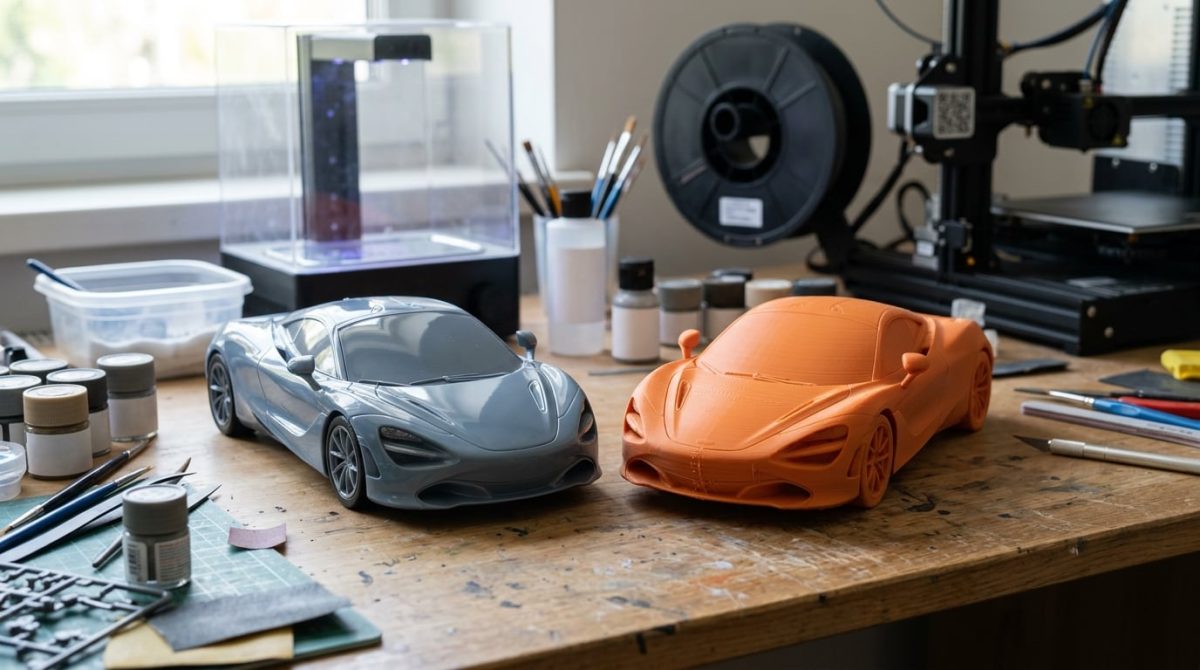



Choosing between the most popular model scales is the first decision of every print. This guide compares 1:24, 1:32, 1:43 and 1:64 by build volume, detail, shelf space and diecast compatibility.
Understanding model scales is the single most useful skill you can pick up before pressing "print" on your next STL file. A scale is simply a ratio: at 1:24, one unit on the model equals 24 units on the real vehicle. That sounds simple, yet the number you choose decides how big the part is, how much detail survives, where it fits on your printer bed, and whether it will sit comfortably next to the diecast cars you already own.
This guide walks through the four scales hobbyists ask about most: 1:24, 1:32, 1:43 and 1:64. For each one we cover typical size, realistic detail, printer requirements and the kind of collection it suits. By the end you will know exactly which ratio fits your machine, your shelf and your budget.
Four ratios, one decision
Every STL can be resized, but each ratio has a sweet spot. Here is the quick picture before we dig in.
How Model Scales Work
A scale is a fraction. In 1:43, every real-world measurement is divided by 43. A car that is 4,300 mm long becomes exactly 100 mm long. The larger the second number, the smaller the model, which is the opposite of what many newcomers expect.
To work out a model’s length quickly, divide the real vehicle’s length in millimetres by the scale number. A typical sports car measuring about 4,500 mm comes out near 188 mm at 1:24, 141 mm at 1:32, 105 mm at 1:43 and 70 mm at 1:64. Those are approximations, because real cars vary, but the pattern is reliable.
Remember that scale is linear. Halving the ratio does not halve the volume of plastic or resin: it changes it by a factor of eight. That is why moving from 1:64 up to 1:24 makes a print dramatically heavier, slower and more expensive, even though the car only looks "a bit bigger".
Why scale matters more for 3D printing
With injection-moulded kits, the manufacturer chooses the scale for you. With STL files, you decide. That freedom is a gift, but it comes with consequences: thin mirrors, door handles, grille bars and wipers have minimum sizes below which a printer simply cannot reproduce them.
The practical rule is that a smaller scale demands a finer printer, while a larger scale demands a bigger one. Everything else in this article builds on that trade-off.
The Four Scales at a Glance
1:24 scale
The classic size for large plastic kits, with room for visible interior detail, separate wheels and openable parts. It rewards patience and a roomy printer.
1:32 scale
Popular with slot-car and farm-vehicle collectors. It stays big enough for fine work yet fits more comfortably on mid-size printers and shelves.
1:43 scale
The traditional European diecast size, ideal for building a dense, consistent shelf of road cars, rally cars and race cars.
1:64 scale
The size of small diecast toy cars. Perfect for large collections and dioramas, but demanding in terms of printer resolution.
Printing at 1:24 Scale: Maximum Presence
1:24 Scale: Big, Bold and Detailed
The 1:24 scale is where scale modelling began for many hobbyists, and it remains the most rewarding for display builds. At this size a steering wheel, seat stitching pattern or brake disc is large enough to be painted properly with a regular brush.
The main cost is printer capacity. A 190 mm car with a rear wing may exceed the footprint of small resin machines, which is where your 3D printer build volume becomes the deciding factor. FDM printers with 220-256 mm beds handle it comfortably, though you may need to tilt or split the body.
Print time also grows quickly. Expect a full 1:24 body to take many hours on FDM, and substantially more material than smaller scales. If you want a cleaner finish, our comparison of resin vs FDM for scale model cars explains which technology suits each stage.
Many 1:24 builders print the body in several parts: shell, chassis, wheels and interior. Splitting the model reduces supports, makes painting easier and lets you swap colours without masking. It also means a modest bed can still produce a large-looking car.
Printing at 1:32 Scale: The Practical Middle Ground
At 1:32, models are roughly three-quarters the size of 1:24, which means about 42% of the volume. That reduction transforms print time and filament use while keeping details legible. It is also the natural home of agricultural and construction vehicles, because many commercial toy tractors and farm machines use this ratio.
If your hobby leans towards machinery, our guide to classic tractor STL models is a good place to find subjects that look right at 1:32. Tractors have chunky, forgiving shapes, so they print well even on budget FDM machines.
For road cars, 1:32 suits people who want presence without dedicating an entire cabinet. A shelf holding a dozen cars at 1:24 might take two shelves at the same spacing, while 1:32 fits more subjects per row and still shows off interior and wheel detail.
Slot cars and play value
Because this size has long been used for slot-car racing and toy vehicles, a printed 1:32 model also works as a robust playing piece or a sturdy diorama inhabitant. Moderately thicker walls make parts less fragile than at 1:64.
Printing at 1:43 Scale: The Collector’s Standard
1:43 Scale: Dense Collections, Fine Detail
The 1:43 scale became the traditional European collector’s size because it balances detail with space. A hundred cars fit in a single display case, which explains its enduring popularity among serious collectors.
For printing, this size sits right on the boundary where resin starts to outperform FDM. A 0.4 mm nozzle struggles to render grille slats and mirror stalks at this size, while a typical resin printer resolves them cleanly. Layer heights of 0.03-0.05 mm preserve body lines and panel gaps.
Painting is manageable, though you will want fine brushes and decent lighting. Masking windows, lights and trim becomes an art form of its own. Many collectors finish 1:43 builds with gloss varnish to mimic the shiny paint of factory diecast.
Why 1:43 suits mixed collections
If you already own commercial diecast at this ratio, printed models blend in seamlessly. That is true of road cars, rally cars and race cars alike. It is also the most forgiving ratio for mixing eras, because the sizes are consistent across brands.
Printing at 1:64 Scale: Tiny but Mighty
The 1:64 scale is the world of small diecast cars sold in blister packs. A sports car ends up around 70 mm long, small enough to hold between two fingers. That makes it ideal for dioramas, dense garages and display cases where space is scarce.
The challenge is resolution. At this size, a 0.2 mm feature on the real car-model translates to a fraction of a millimetre. Mirrors, antennas and wipers often need to be thickened slightly or omitted. A resin printer with a 4K or better screen is practically essential, and FDM is rarely worth attempting for anything beyond simple shapes.
Printing many cars at once is the real advantage here. A small build plate can hold a dozen 1:64 bodies in a single job, which makes it the most productive scale for batch printing. If you want to build a whole parking lot or a diorama street, no other ratio gets you there as quickly.
Smaller scale means finer printer, not simpler model
Many beginners assume small models are easier. The opposite is usually true: shrinking a design pushes thin features below what your printer can resolve. Choose the scale that matches your machine’s resolution first, then pick the subject.
Comparing Specifications Side by Side
The table below summarises what changes as you move between ratios. Lengths assume a car roughly 4,500 mm long and are approximate.
| Scale | Approx. length | Volume vs 1:24 | Best printer | Detail level | Shelf efficiency |
|---|---|---|---|---|---|
| 1:24 | ~188 mm | 100% | FDM or large resin | Very high | Low |
| 1:32 | ~141 mm | ~42% | FDM or resin | High | Medium |
| 1:43 | ~105 mm | ~18% | Resin | Medium-high | High |
| 1:64 | ~70 mm | ~5% | Resin (high-res) | Medium | Very high |
Notice how quickly the volume drops. A 1:64 car uses roughly one-twentieth of the material of the same car at 1:24. If you are on a budget or want to test a design before committing, printing a small version first is an inexpensive way to check proportions.
Matching Scale to Your Printer
Know your build volume
Your 3D printer build volume sets the hard ceiling. Measure the longest dimension of the model at your chosen scale, add space for supports and orientation, and compare it to your bed. Printing diagonally can gain you extra length, but it affects surface quality and supports.
As a rough guide: small resin printers with beds around 120 x 70 mm handle 1:43 and 1:64 comfortably. Mid-size resin machines handle 1:32 for most cars. Large-format resin or FDM printers with 220 mm or more are best for 1:24. If you are shopping for a machine, our roundup of the best 3D printers in 2026 compares popular options by volume and quality.
Think about resolution too
Volume is only half the story. A big printer with coarse resolution still cannot reproduce 1:64 details. Check XY resolution on resin printers and nozzle diameter on FDM machines, then keep in mind that features thinner than about two nozzle widths will be fragile or missing.
Diecast Collection Compatibility
If you already own diecast cars, matching scale is the whole point. A printed model at the wrong ratio looks out of place next to its neighbours, even if both are beautifully finished. This is where diecast collection compatibility deserves attention before you start resizing STLs.
Most diecast ranges follow a handful of standards. Small toy cars are usually 1:64, collector-grade European models are commonly 1:43, and larger premium models come in 1:24 and 1:18. Always check the stated scale on the box rather than relying on appearance, because some "pocket" ranges are not truly to scale and vary from car to car.
Checking true scale before printing
Place a real diecast car beside a ruler, measure its length, and compare it with the actual vehicle’s length. Divide the real length by the model length to confirm the ratio. If your measurement is close to 43 or 64, you can resize the STL accordingly.
For the best match, scale the STL by the exact factor and print a quick test. Then set it beside your diecast car under the same light. Minor differences in ride height and wheel size are normal; it is overall length, width and stance you want to align.
Wheels, ride height and stance
Diecast manufacturers often exaggerate wheel size and lower the stance for visual drama. If you want a printed car to look at home among them, you may want to nudge wheels slightly larger or lower the body a touch in your slicer or modelling software. Such tweaks are subtle but make a noticeable difference.
Planning Shelf Space
Space is the quiet constraint that ends many collections. Before you commit to a ratio, sketch your display area and count how many models fit. A standard shelf 300 mm deep and 900 mm wide holds about four 1:24 cars in a row, six or seven at 1:32, nine at 1:43, and more than twelve at 1:64.
Allow breathing room between models. Cramped displays make detailed cars look like toys in a box. Leave at least a third of a car’s width between neighbours, and consider tilting a few models slightly to catch light.
Plan the shelf before the printer
Decide how many models you want to show and where they will live. Working backwards from shelf capacity to scale prevents the common mistake of printing a dozen 1:24 cars and then discovering there is nowhere to put them.
Dust, light and protection
Larger scales collect more dust and are more exposed to damage, while smaller scales are easier to protect in cases. Acrylic display boxes exist in all common sizes, and a sealed case is worth the investment for finished resin models that you have spent hours painting.
Models to Print at Each Scale
Not every design suits every ratio. Subjects with bold, simple shapes handle small scales well, while detailed supercars reward larger ones. Here are several designs and the scale where each tends to shine.
For a compact, forgiving build, Kia Picanto GT-Line 2017 is a good small-car candidate that works nicely at 1:43 or 1:64, where its simple lines print cleanly.
If you want a dramatic centrepiece, Ford GT 2017 suits the larger ratios, where its aero details and wide stance have room to breathe.
Honda NSX 2017 is another strong choice for 1:32 or 1:43, with flowing surfaces that look excellent when finished in glossy paint.
Truck fans can try Ford F-150 Raptor 2017, a rugged pickup that holds up well at 1:32 and 1:43, with chunky proportions that survive the move to smaller sizes.
For something different, Mil Mi-24 Hind Attack Helicopter brings a helicopter into the mix, a good test of thin rotor-adjacent detail at 1:72 equivalents or similar sizes if you resize it to suit your shelf.
Finally, Bugatti Chiron 2016 is a hypercar that rewards the finest printers, so it is an excellent project once you have mastered smaller scales.
If you enjoy American subjects, our Chevrolet STL collection and classic muscle car roundup offer plenty of further options to scale.
Which Scale Should You Choose?
Go for 1:24. It gives you room for interiors, separate parts and expressive painting, provided your printer can handle the footprint and print time.
Choose 1:32. It matches many commercial toys and keeps heavy, chunky subjects at a manageable size on mid-range printers.
Pick 1:43. It is the classic collector standard, and resin printers handle it with excellent results in a compact footprint.
Use 1:64. Batch printing on a small resin printer lets you fill a diorama or garage in a single afternoon at minimal cost.
Frequently Asked Questions
What is the difference between 1:24 and 1:64 scale?
At 1:24, the model is 24 times smaller than the real vehicle; at 1:64, it is 64 times smaller. A 4.5 m car is about 188 mm long at 1:24 and about 70 mm at 1:64. The larger scale shows far more detail but needs much more space, material and printing time.
Can I resize any STL file to a different scale?
Yes, most slicers and modelling tools let you scale a model by percentage. The catch is that thin features may become too small to print or too fragile to handle. Always preview the sliced result and consider thickening mirrors, antennas and trim before shrinking a design.
Is resin or FDM better for small scales like 1:43 and 1:64?
Resin is generally better for small ratios because it resolves fine detail that a 0.4 mm nozzle cannot. FDM works well at 1:24 and sometimes 1:32. For a deeper comparison, see our guide to resin versus FDM for scale model cars.
How do I know a diecast car’s real scale?
Check the box first, then verify by measuring the model and dividing the real vehicle’s length by that measurement. Some ranges are only approximately to scale, so a quick check prevents mismatches when you display printed models alongside them.
Which scale is best for beginners?
Many beginners start with 1:32 or 1:43. They are large enough to forgive small mistakes yet small enough to print quickly and store easily. Once you are comfortable with supports and finishing, moving to 1:24 or 1:64 is straightforward.
Final Thoughts
Choosing among the common model scales is really a question about priorities. If detail and display presence matter most, 1:24 is hard to beat. If balance and versatility are your goals, 1:32 delivers. For collectors who want consistency with existing shelves, 1:43 is the safe, proven choice, and 1:64 is the answer when quantity and space matter more than every last rivet.
Start by measuring your printer, your shelf and your existing collection, then let those three numbers point to the right ratio. Print a small test, compare it to a diecast car, and adjust before committing to a long job. With that approach, every STL you download will end up exactly the size you intended, looking right the moment it comes off the bed.
Sources
Official pages consulted at the time of publication. Manufacturers may update specifications, firmware and bundles at any time.